New Indicators Rattle Investors – Weekly Update
February 25, 2025 | By Steven DiGregorio

Stocks fell last week as concerns about sticky inflation and the pace of economic growth rattled investors.
The Standard & Poor’s 500 Index declined 1.66 percent, while the Nasdaq Composite Index dropped 2.51 percent. The Dow Jones Industrial Average also fell 2.51 percent. The MSCI EAFE Index, which tracks developed overseas stock markets, was essentially flat (+0.04 percent).1,2
S&P 500 Hits New High, Then Slips
Following the Presidents’ Day holiday, stock prices were largely range-bound on Tuesday despite some intraday volatility. Then stocks edged higher, shaking off some new tariff talk and disappointing housing starts data. The S&P 500 marked its third record close of the year on Wednesday.3,4
On Thursday, stocks were under pressure from the start of trading after a weaker-than-expected outlook from a mega-retailer. The update reinforced some concerns that the economy may be slowing. The selling accelerated on Friday after a consumer sentiment survey showed investors are unsettled about the inflation outlook.
Friday’s decline was the worst of the young year.5
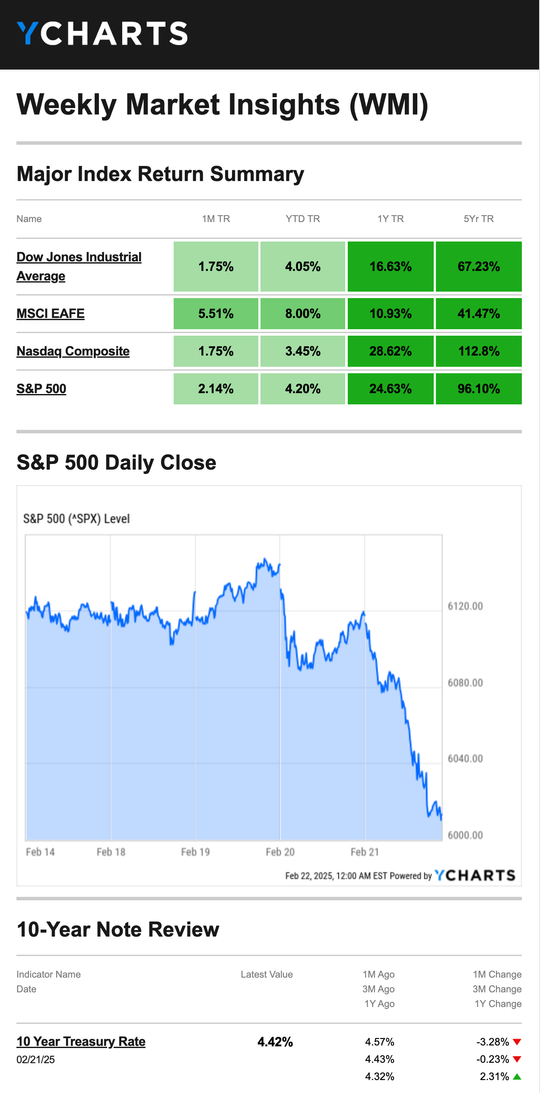
Source: YCharts.com, February 22, 2025. Weekly performance is measured from Friday, February 14, to Friday, February 21. TR = total return for the index, which includes any dividends as well as any other cash distributions during the period. Treasury note yield is expressed in basis points.
Economic Jitters
Investors were forced to navigate a week of disappointing news about the economy and inflation.
First, traders were surprised to hear about slowing demand at the country’s biggest retailer, which soured the outlook for the consumer and the economy. Then, the University of Michigan Consumer Confidence survey fell by 10 percent in February as consumers expressed concerns about higher inflation ahead of possible new tariffs.6
This combination prompted investors to move into a “risk-off” position before the weekend.
This Week: Key Economic Data
Tuesday: Consumer Confidence. Fed Officials Lorie Logan and Thomas Barkin speak.
Wednesday: New Home Sales. Fed Officials Thomas Barkin and Raphael Bostic speak.
Thursday: Gross Domestic Product (GDP). Durable Goods. Weekly Jobless Claims. Pending Home Sales. Fed Balance Sheet.
Friday: Personal Consumption and Expenditures (PCE) Index.
Source: Investors Business Daily – Econoday economic calendar; February 21, 2025
The Econoday economic calendar lists upcoming U.S. economic data releases (including key economic indicators), Federal Reserve policy meetings, and speaking engagements of Federal Reserve officials. The content is developed from sources believed to be providing accurate information. The forecasts or forward-looking statements are based on assumptions and may not materialize. The forecasts also are subject to revision.
This Week: Companies Reporting Earnings
Tuesday: The Home Depot, Inc. (HD), Intuit Inc. (INTU)
Wednesday: NVIDIA Corporation (NVDA), Salesforce Inc. (CRM), Lowe’s Companies, Inc. (LOW), The TJX Companies, Inc. (TJX)
Thursday: Dell Technologies Inc. (DELL)
Friday: Berkshire Hathaway Inc. (BRK.A,BRK.B)
Source: Zacks, February 21, 2025. Companies mentioned are for informational purposes only. It should not be considered a solicitation for the purchase or sale of the securities. Investing involves risks, and investment decisions should be based on your own goals, time horizon, and tolerance for risk. The return and principal value of investments will fluctuate as market conditions change. When sold, investments may be worth more or less than their original cost. Companies may reschedule when they report earnings without notice.
Footnotes and Sources
1. The Wall Street Journal, February 21, 2025
2. Investing.com, February 21, 2025
3. CNBC.com, February 18, 2025
4. The Wall Street Journal, February 19, 2025
5. CNBC.com, February 21, 2025
6. The Wall Street Journal, February 21, 2025
Share the Wealth of Knowledge!
Please share this market update with family, friends, or colleagues.
We love being introduced!
The content of this article is for informational purposes only and is not intended as an offer of investment advice, investment strategy or to buy, transfer or sell any security or other investment vehicle. Information contained herein has been obtained from sources deemed reliable but Spire Wealth Management LLC, Spire Securities LLC and their affiliates, including Compass Asset Management Group LLC, do not guarantee its accuracy. The views and opinions expressed in this article are those of the authors and do not necessarily reflect the opinions of Spire Wealth Management LLC, Spire Securities LLC or its affiliates.
Spire Wealth Management LLC is a federally Registered Investment Advisor. Securities offered through an affiliate, Spire Securities LLC. Member FINRA/SIPC
By accessing any links contained in this article you will be leaving Spire Wealth Management LLC & its affiliates and Compass Asset Management Group LLC websites and entering a website hosted by another party. Although Spire Wealth Management LLC & its affiliates and Compass Asset Management Group LLC have approved these as reliable partner sites, please be advised that you will no longer be subject to, or under the protection of, the privacy and security policies of Spire Wealth Management LLC & its affiliates Compass Asset Management Group LLC websites. The other parties are solely responsible for the content of their websites. We encourage you to read and evaluate the privacy and security policies on the sites you are entering, which may be different than those of Spire Wealth Management LLC & its affiliates Compass Asset Management Group LLC.
Diversification does not guarantee profit nor is it guaranteed to protect assets.
International investing involves special risks such as currency fluctuation and political instability and may not be suitable for all investors.
The Standard & Poor’s 500 (S&P 500) is an unmanaged group of securities considered to be representative of the stock market in general.
The Dow Jones Industrial Average is a price-weighted average of 30 significant stocks traded on the New York Stock Exchange and the NASDAQ. The DJIA was invented by Charles Dow back in 1896.
The Nasdaq Composite is an index of the common stocks and similar securities listed on the NASDAQ stock market and is considered a broad indicator of the performance of stocks of technology companies and growth companies.
The MSCI EAFE Index was created by Morgan Stanley Capital International (MSCI) that serves as a benchmark of the performance in major international equity markets as represented by 21 major MSCI indices from Europe, Australia, and Southeast Asia.
The 10-year Treasury Note represents debt owed by the United States Treasury to the public. Since the U.S. Government is seen as a risk-free borrower, investors use the 10-year Treasury Note as a benchmark for the long-term bond market.
Opinions expressed are subject to change without notice and are not intended as investment advice or to predict future performance.
Past performance does not guarantee future results.
You cannot invest directly in an index.
Consult your financial professional before making any investment decision.
Fixed income investments are subject to various risks including changes in interest rates, credit quality, inflation risk, market valuations, prepayments, corporate events, tax ramifications and other factors.
By clicking on these links, you will leave our server, as the links are located on another server. We have not independently verified the information available through this link. The link is provided to you as a matter of interest.
Tags: consumer sentiment, economy, GDP, Inflation, Tariffs
