Markets Retreat After Data-Heavy Week – Weekly Update
August 4, 2025 | By Steven DiGregorio

Stocks fell last week as investors assessed progress on trade negotiations, new U.S. tariffs, and fresh data on the U.S. economy.
The Standard & Poor’s 500 Index fell 2.36 percent, while the Nasdaq Composite Index declined 2.17 percent. The Dow Jones Industrial Average dropped 2.92 percent. The MSCI EAFE Index, which tracks developed overseas stock markets, lost 2.95 percent.1,2
Action-Packed Week
Stocks largely went sideways over the first half of the week as investors waited for more Q2 corporate results, fresh economic data, and the Fed decision.
The U.S.-E.U. trade agreement announced over the weekend had a muted impact on the market as the week began. Stocks then retreated as China trade talks appeared to stall, with the Dow declining the most of the three major averages through midweek.3,4
Stocks gained on Wednesday morning after the latest gross domestic product (GDP) report showed consumer spending powered the economy back to 3 percent annualized growth in Q2. That afternoon, the Federal Reserve announced they were holding rates steady, which put some pressure on stocks.5
Selling pressure continued on July’s final trading day as investors continued to fret about the Fed’s next move. The Personal Consumption and Expenditures (PCE) Index—the Fed’s favored inflation metric—showed a June uptick in core goods prices, unsettling investors.5
Stocks were under pressure from the opening bell on Friday as investors sorted through fresh tariff announcements from the White House, a softer-than-expected July jobs report, and mixed Q2 corporate reports from two megacap tech names.6,7
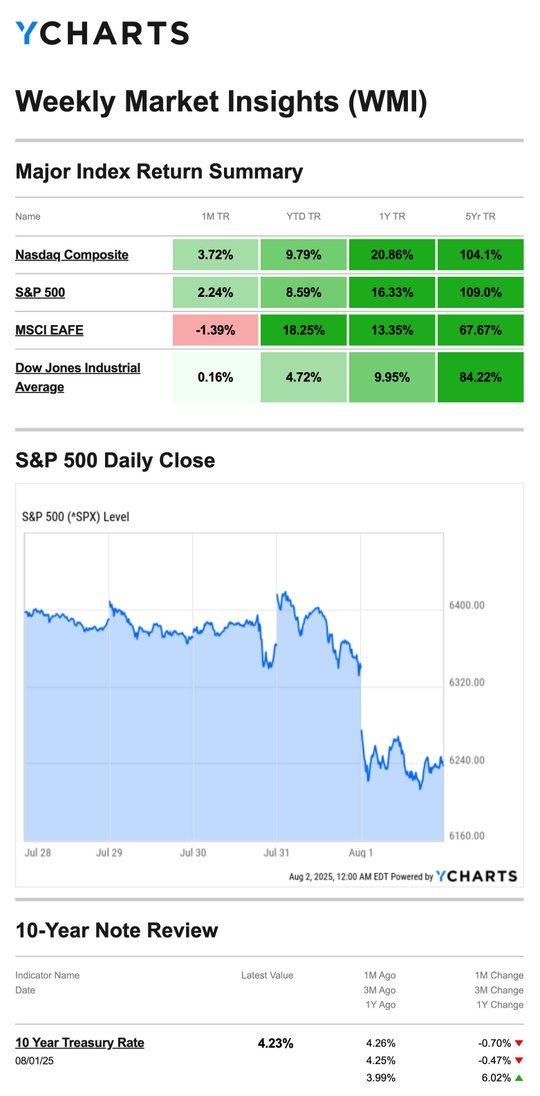
Source: YCharts.com, August 2, 2025. Weekly performance is measured from Monday, July 28, to Friday, August 1. TR = total return for the index, which includes any dividends as well as any other cash distributions during the period. Treasury note yield is expressed in basis points.
Mixed Economic Signals
There was a trove of economic data for investors to parse last week.
First, there was economic growth. While 3 percent GDP growth in Q2 is a solid step up from a 0.5 percent contraction in Q1, consumer spending largely drove the increase, offset by slower business spending—especially investment in equipment and buildings.8
The PCE report showed why the Fed remains focused on inflation. Finally, Friday’s jobs report pointed to a slowdown in hiring in July. A bit more concerning was that the jobs data from prior months were revised lower.
The Fed has no meeting in August, with three other meetings scheduled for 2025.
This Week: Key Economic Data
Monday: Factory Orders. Motor Vehicles Sales.
Tuesday: Trade Deficit. ISM Services Index.
Wednesday: Treasury Buyback Announcement. 10-Year Treasury Note Auction. San Francisco Fed President Mary Daly speaks.
Thursday: Productivity and Costs. Weekly Jobless Claims. Wholesale Inventories. Consumer Credit. Fed Balance Sheet. Atlanta Fed President Raphael Bostic speaks.
Friday: St. Louis Fed President Alberto Musalem speaks.
Source: Investors Business Daily – Econoday economic calendar; August 1, 2025
The Econoday economic calendar lists upcoming U.S. economic data releases (including key economic indicators), Federal Reserve policy meetings, and speaking engagements of Federal Reserve officials. The content is developed from sources believed to be providing accurate information. The forecasts or forward-looking statements are based on assumptions and may not materialize. The forecasts also are subject to revision.
This Week: Companies Reporting Earnings
Monday: Palantir Technologies Inc. (PLTR), Vertex Pharmaceuticals Incorporated (VRTX)
Tuesday: Advanced Micro Devices, Inc. (AMD), Caterpillar Inc. (CAT), Amgen Inc. (AMGN), Arista Networks, Inc. (ANET), Pfizer Inc. (PFE), Duke Energy Corporation (DUK)
Wednesday: McDonald’s Corporation (MCD), The Walt Disney Company (DIS), Uber Technologies, Inc. (UBER), Shopify Inc. (SHOP), AppLovin Corporation (APP), DoorDash Inc. (DASH), Brookfield Asset Management Ltd. (BAM)
Thursday: Eli Lilly and Company (LLY), Gilead Sciences, Inc. (GILD), ConocoPhillips (COP), Constellation Energy Corporation (CEG)
Source: Zacks, August 1, 2025. Companies mentioned are for informational purposes only. It should not be considered a solicitation for the purchase or sale of the securities. Investing involves risks, and investment decisions should be based on your own goals, time horizon, and tolerance for risk. The return and principal value of investments will fluctuate as market conditions change. When sold, investments may be worth more or less than their original cost. Companies may reschedule when they report earnings without notice.
Footnotes And Sources
1. WSJ.com, August 1, 2025
2. Investing.com, August 1, 2025
3. CNBC.com, July 28, 2025
4. CNBC.com, July 29, 2025
5. WSJ.com, July 31, 2025
6. MarketWatch.com, August 1, 2025
7. WSJ.com, August 1, 2025
8. WSJ.com, July 30, 2025
Share the Wealth of Knowledge!
Please share this market update with family, friends, or colleagues.
We love being introduced!
The content of this article is for informational purposes only and is not intended as an offer of investment advice, investment strategy or to buy, transfer or sell any security or other investment vehicle. Information contained herein has been obtained from sources deemed reliable but Spire Wealth Management LLC, Spire Securities LLC and their affiliates, including Compass Asset Management Group LLC, do not guarantee its accuracy. The views and opinions expressed in this article are those of the authors and do not necessarily reflect the opinions of Spire Wealth Management LLC, Spire Securities LLC or its affiliates.
Compass Asset Management Group does not provide tax, legal or accounting advice. This material has been prepared for informational purposes only, and is not intended to provide, and should not be relied on for, tax, legal or accounting advice. Please consult your own tax, legal and accounting advisors before engaging in any transaction.
Spire Wealth Management LLC is a federally Registered Investment Advisor. Securities offered through an affiliate, Spire Securities LLC. Member FINRA/SIPC
By accessing any links contained in this article you will be leaving Spire Wealth Management LLC & its affiliates and Compass Asset Management Group LLC websites and entering a website hosted by another party. Although Spire Wealth Management LLC & its affiliates and Compass Asset Management Group LLC have approved these as reliable partner sites, please be advised that you will no longer be subject to, or under the protection of, the privacy and security policies of Spire Wealth Management LLC & its affiliates Compass Asset Management Group LLC websites. The other parties are solely responsible for the content of their websites. We encourage you to read and evaluate the privacy and security policies on the sites you are entering, which may be different than those of Spire Wealth Management LLC & its affiliates Compass Asset Management Group LLC.
Diversification does not guarantee profit nor is it guaranteed to protect assets.
International investing involves special risks such as currency fluctuation and political instability and may not be suitable for all investors.
The Standard & Poor’s 500 (S&P 500) is an unmanaged group of securities considered to be representative of the stock market in general.
The Dow Jones Industrial Average is a price-weighted average of 30 significant stocks traded on the New York Stock Exchange and the NASDAQ. The DJIA was invented by Charles Dow back in 1896.
The Nasdaq Composite is an index of the common stocks and similar securities listed on the NASDAQ stock market and is considered a broad indicator of the performance of stocks of technology companies and growth companies.
The MSCI EAFE Index was created by Morgan Stanley Capital International (MSCI) that serves as a benchmark of the performance in major international equity markets as represented by 21 major MSCI indices from Europe, Australia, and Southeast Asia.
The 10-year Treasury Note represents debt owed by the United States Treasury to the public. Since the U.S. Government is seen as a risk-free borrower, investors use the 10-year Treasury Note as a benchmark for the long-term bond market.
Opinions expressed are subject to change without notice and are not intended as investment advice or to predict future performance.
Past performance does not guarantee future results.
You cannot invest directly in an index.
Consult your financial professional before making any investment decision.
Fixed income investments are subject to various risks including changes in interest rates, credit quality, inflation risk, market valuations, prepayments, corporate events, tax ramifications and other factors.
By clicking on these links, you will leave our server, as the links are located on another server. We have not independently verified the information available through this link. The link is provided to you as a matter of interest.
Tags: DJIA, economy, employment, Inflation, NASDAQ, S&P 500, Tariffs, Trade
