Stocks Rise Ahead of Fed Meeting – Weekly Update
September 15, 2025 | By Steven DiGregorio

Stocks posted a solid gain last week, riding a rally in megacap tech stocks while overcoming interest rate anxiety, a downward revision to jobs data, and mixed inflation reports.
The Standard & Poor’s 500 Index rose 1.59 percent, while the Nasdaq Composite Index climbed 2.03 percent. The Dow Jones Industrial Average added 0.95 percent. The MSCI EAFE Index, which tracks developed overseas stock markets, gained 1.18 percent.1,2
Stocks At New Highs
Stocks rose to start the week on renewed AI enthusiasm, with the Nasdaq hitting a new record intraday high. Stocks continued to push ahead on Tuesday despite fresh data showing large downward revisions to job creation for the 12 months through March.3
The rally continued midweek after an unexpected drop in wholesale inflation appeared to boost investors’ hopes for Fed rate moves before the year’s end.4,5
Investors cheered Thursday’s consumer inflation report, anticipating that the reading wouldn’t be enough to derail a Fed rate move this month. The S&P and Nasdaq posted record intraday highs and closes three days in a row, while the Dow Industrials cracked 46,000 for the first time.6
The Nasdaq hit a new record close on Friday, while the S&P 500 flattened out and the Dow posted a modest loss on the week’s last day of trading.7
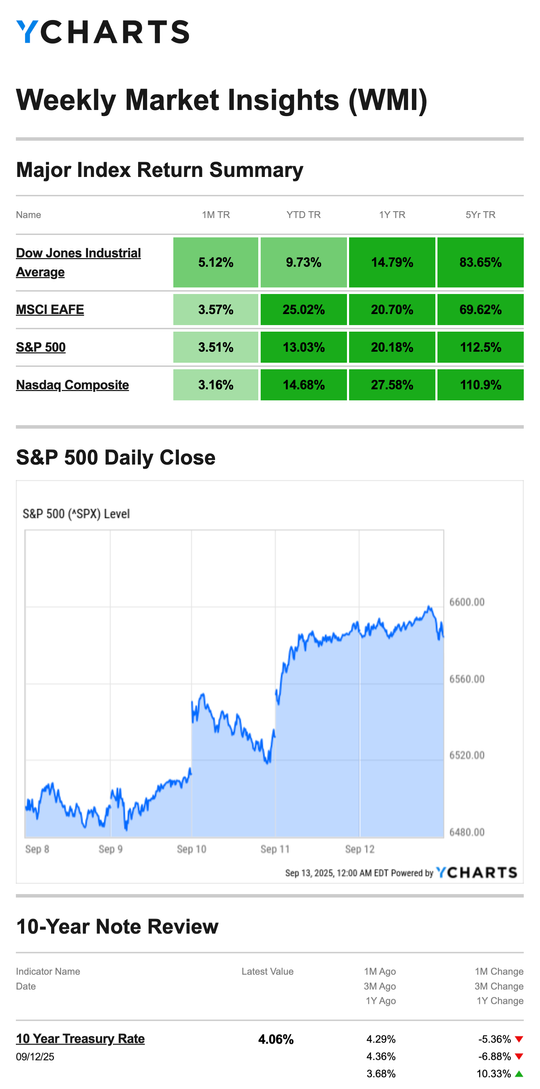
Source: YCharts.com, September 13, 2025. Weekly performance is measured from Friday, September 8, to Friday, September 12. TR = total return for the index, which includes any dividends as well as any other cash distributions during the period. Treasury note yield is expressed in basis points.
Fed Meets After Mixed Inflation Reports
Wednesday’s Producer Price Index (PPI) report showed wholesale prices fell 0.1 percent in August after a 0.7 percent increase in July. Then, on Thursday, fresh Consumer Price Index (CPI) data showed that retail prices rose a hotter-than-expected 0.4 percent in August—faster than July’s 0.3 percent gain.8,9
All eyes will be on Fed Chair Powell this week. He is expected to outline his plan to adjust rates at the Fed’s scheduled two-day meeting, which ends on Wednesday, September 17. Investors will be looking for insights about how he plans to guide the economy through this period of sluggish job growth and stubborn consumer inflation.
This Week: Key Economic Data
Tuesday: Retail Sales. Import Price Index. Industrial Production. Business Inventories. Home Builder Confidence Index.
Wednesday: Housing Starts. Building Permits. Federal Reserve Interest Rate Decision. Fed Chair Powell Press Conference.
Thursday: Weekly Jobless Claims. Leading Economic Indicators.
Source: Investors Business Daily – Econoday economic calendar; September 12, 2025. The Econoday economic calendar lists upcoming U.S. economic data releases (including key economic indicators), Federal Reserve policy meetings, and speaking engagements of Federal Reserve officials. The content is developed from sources believed to be providing accurate information. The forecasts or forward-looking statements are based on assumptions and may not materialize. The forecasts also are subject to revision.
This Week: Companies Reporting Earnings
Wednesday: General Mills, Inc. (GIS)
Thursday: FedEx Corporation (FDX)
Source: Zacks, September 12, 2025. Companies mentioned are for informational purposes only. It should not be considered a solicitation for the purchase or sale of the securities. Investing involves risks, and investment decisions should be based on your own goals, time horizon, and tolerance for risk. The return and principal value of investments will fluctuate as market conditions change. When sold, investments may be worth more or less than their original cost. Companies may reschedule when they report earnings without notice.
Footnotes and Sources
1. WSJ.com, September 12, 2025
2. Investing.com, September 12, 2025
3. WSJ.com, September 8, 2025
4. CNBC.com, September 9, 2025
5. WSJ.com, September 10, 2025
6. CNBC.com, September 11, 2025
7. CNBC.com, September 12, 2025
8. WSJ.com, September 10, 2025
9. WSJ.com, September 11, 2025
Share the Wealth of Knowledge!
Please share this market update with family, friends, or colleagues.
We love being introduced!
The content of this article is for informational purposes only and is not intended as an offer of investment advice, investment strategy or to buy, transfer or sell any security or other investment vehicle. Information contained herein has been obtained from sources deemed reliable but Spire Wealth Management LLC, Spire Securities LLC and their affiliates, including Compass Asset Management Group LLC, do not guarantee its accuracy. The views and opinions expressed in this article are those of the authors and do not necessarily reflect the opinions of Spire Wealth Management LLC, Spire Securities LLC or its affiliates.
Compass Asset Management Group does not provide tax, legal or accounting advice. This material has been prepared for informational purposes only, and is not intended to provide, and should not be relied on for, tax, legal or accounting advice. Please consult your own tax, legal and accounting advisors before engaging in any transaction.
Spire Wealth Management LLC is a federally Registered Investment Advisor. Securities offered through an affiliate, Spire Securities LLC. Member FINRA/SIPC
By accessing any links contained in this article you will be leaving Spire Wealth Management LLC & its affiliates and Compass Asset Management Group LLC websites and entering a website hosted by another party. Although Spire Wealth Management LLC & its affiliates and Compass Asset Management Group LLC have approved these as reliable partner sites, please be advised that you will no longer be subject to, or under the protection of, the privacy and security policies of Spire Wealth Management LLC & its affiliates Compass Asset Management Group LLC websites. The other parties are solely responsible for the content of their websites. We encourage you to read and evaluate the privacy and security policies on the sites you are entering, which may be different than those of Spire Wealth Management LLC & its affiliates Compass Asset Management Group LLC.
Diversification does not guarantee profit nor is it guaranteed to protect assets.
International investing involves special risks such as currency fluctuation and political instability and may not be suitable for all investors.
The Standard & Poor’s 500 (S&P 500) is an unmanaged group of securities considered to be representative of the stock market in general.
The Dow Jones Industrial Average is a price-weighted average of 30 significant stocks traded on the New York Stock Exchange and the NASDAQ. The DJIA was invented by Charles Dow back in 1896.
The Nasdaq Composite is an index of the common stocks and similar securities listed on the NASDAQ stock market and is considered a broad indicator of the performance of stocks of technology companies and growth companies.
The MSCI EAFE Index was created by Morgan Stanley Capital International (MSCI) that serves as a benchmark of the performance in major international equity markets as represented by 21 major MSCI indices from Europe, Australia, and Southeast Asia.
The 10-year Treasury Note represents debt owed by the United States Treasury to the public. Since the U.S. Government is seen as a risk-free borrower, investors use the 10-year Treasury Note as a benchmark for the long-term bond market.
Opinions expressed are subject to change without notice and are not intended as investment advice or to predict future performance.
Past performance does not guarantee future results.
You cannot invest directly in an index.
Consult your financial professional before making any investment decision.
Fixed income investments are subject to various risks including changes in interest rates, credit quality, inflation risk, market valuations, prepayments, corporate events, tax ramifications and other factors.
By clicking on these links, you will leave our server, as the links are located on another server. We have not independently verified the information available through this link. The link is provided to you as a matter of interest.
Tags: AI, DJIA, Inflation, NASDAQ, S&P 500
